Career Quiz
Thirty short situations from school life, five answers each. Pick the answer that sounds like you, because no answer is right or wrong. It takes about 6 minutes, and at the end the quiz names your leading interest type, with six scales beneath it.
Realistic
Realistic types want a task they can see and touch.
In a workshop or a garden, they often start working while the others are still talking it over. A loose bike chain or a wobbly shelf catches their attention at once, and the practical class is the one they look forward to. In the school yard they are the ones holding the other end of a plank.
Tools and real materials are comfortable ground, and many like outdoor work with plants and animals. A carpenter or a park ranger spends the day on exactly this kind of task.
Practical answers come first: when a problem comes up, they look for something that can be built or repaired on the spot. Fixing the thing can come before asking why it broke, and a long discussion may feel slow when nothing has been made yet.
It helps to ask one question, why did it break, before the first turn of the screwdriver.
Investigative
Investigative types keep asking how and why things work.
Science and math lessons hold their attention, and a hard puzzle left unfinished tends to follow them home. Often they read about a topic when nobody has asked, just to see how the pieces fit. In a lab session they ask what would happen if one thing were changed, and then wait to see.
They trust an answer that survives a check, so they test an idea against facts or set up an experiment of their own. It is the habit behind a chemist's or a data analyst's work.
A question gets followed until the explanation holds together. A checked answer can matter more to them than a fresh idea, and a question may stay open for days because one more test seems worth making.
An Investigative type can start by writing down the current answer, however rough, before looking for another check.
Artistic
An Artistic type usually has a half-finished project on the desk.
Drawing, writing, music or video can take up a whole weekend, and a task with no set method feels like open space. Notebook margins fill with sketches, and a margin doodle can turn into a comic by Friday.
They look at shapes and colors with a maker's eye, and a school poster or a stage set gets more interesting once they decide how it looks. Illustrators and actors make that kind of choice for a living.
At school they look for the elective with an open assignment, such as drama or a yearbook layout, and a story begun in one lesson often gets finished under the desk in the next. Hearing exactly how a task must be done irritates them, and a fixed procedure drains the interest from work they would otherwise enjoy.
It is worth keeping a notebook for half-finished ideas.
Social
The classmate who stays to explain it again is often a Social type.
They volunteer to tutor a younger student, and they notice quickly when someone in the group is left out. Group projects and team roles appeal to them more than solo work at a screen. At the end of a club meeting they stack the chairs and ask how everyone's week went.
After a rough day a friend usually finds them nearby, and they remember who was nervous before the test. They keep track of who needs a pen or a second explanation.
They pay attention to what other people need and how they are growing, which is also the daily material of teaching and nursing. Looking after a person can come before moving the group toward its goal, so a deadline may wait while someone is being heard.
A Social type might begin with one goal agreed with the group before the helping starts.
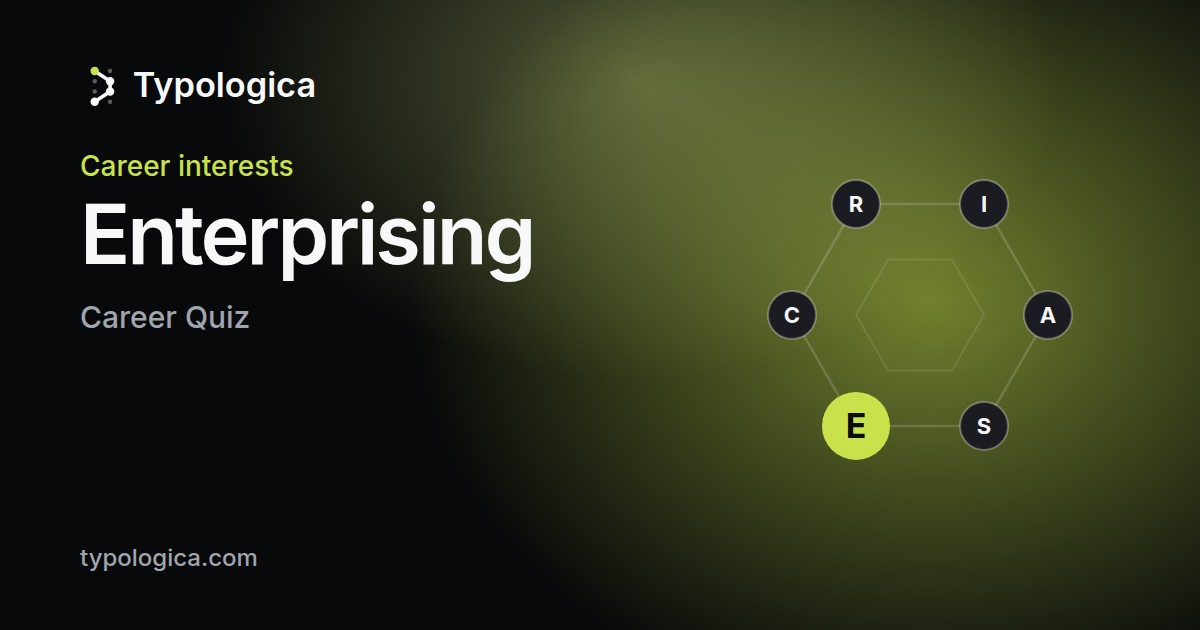
Enterprising
When a group needs someone in charge, the Enterprising type is already standing up.
They organize the school event and talk others into joining. In a club they are often the one who suggests the next project and finds people to do it. A class fundraiser is the kind of activity they look for, and they enjoy the moment when a stranger says yes.
Drive is what carries them: once a goal is set, they push toward it and accept some risk along the way. Before a class vote they count heads early and know who still needs convincing.
Sign-up lists and small details may slip until someone else picks them up, because the goal and the risk get the attention first.
Business and sales are home ground for an entrepreneur, and public affairs for a lawyer.
It pays to ask one friend to look over the plan before the event begins.
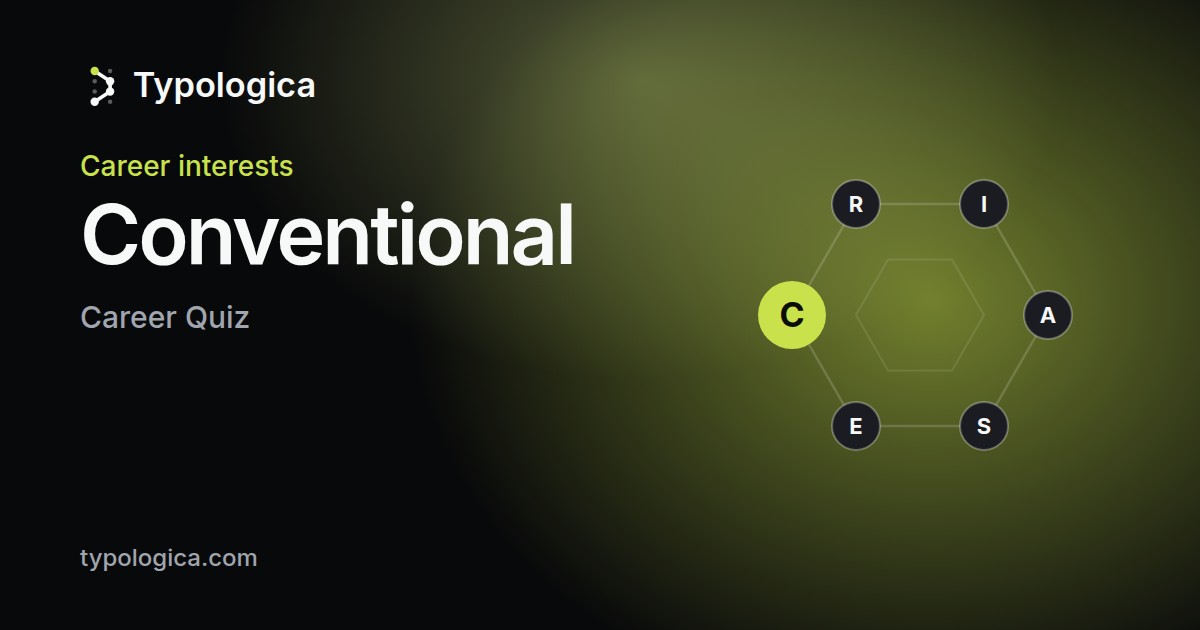
Conventional
Lists and schedules stay in good order wherever a Conventional type is around.
In a club, they are the ones holding the sign-up sheet, and a wrong date or a missing name stands out to them right away. Homework is handed in on time, and a calendar hangs on the wall near the desk.
A clear set of steps feels like solid ground to them, and they check a piece of work line by line before handing it in. A planner filled in a week ahead sits in the bag.
Accuracy and order are what others come to rely on them for. A plan that changes in the middle can throw them off, and a new goal may wait until the old system runs smoothly.
Accounting and database work run on the same kind of order.
A Conventional type could try one task without a checklist and see how it turns out.
Keys 1–4 pick an answer
Continue the test?
Answers not sent
The result didn’t arrive because the site couldn’t be reached. All your answers are saved in this browser, so there’s no need to retake the test.
Your type:
One type that explains it all
Five tests, five results, and not one tells you why the same things keep happening to you. The CoreTypes system gives the answer many people spend years looking for: why your life plays out exactly the way it does.
Take the free testOther types
Select a type to read its description and compare it with yours.
Tests in this system
About the test
Methodology
This quiz is based on the approach of John Holland, a vocational psychologist who described six types of interest: Realistic, Investigative, Artistic, Social, Enterprising and Conventional. The 30 questions were written for this site for students in grades 6 to 12. Each question belongs to one type, five per type, and offers five answers that run from a light pull toward an activity to a strong one.
The answers add up on six scales, each shown from 0 to 100 percent. The type that leads on the scales is the result. In Holland's model the six types lie around a hexagon, with similar types side by side and unlike ones across, so the type names label areas of one map of interests. Every profile is a blend of all six scales, and when several of them sit close together, the interests are still wide, which is an ordinary picture at this age.
The quiz asks about the pull of an activity, and it relies on the answers a person gives about themselves. A short explanation of the six types and the hexagon is on Wikipedia.
Author: Lex Tarrel, Creator of the CoreTypes system
Sources
- Holland, J. L. (1997). Making vocational choices: A theory of vocational personalities and work environments (3rd ed.). Psychological Assessment Resources.
- Nauta, M. M. (2010). The development, evolution, and status of Holland's theory of vocational personalities: Reflections and future directions for counseling psychology. Journal of Counseling Psychology, 57(1), 11–22. doi:10.1037/a0018213
- Low, K. S. D., Yoon, M., Roberts, B. W., & Rounds, J. (2005). The stability of vocational interests from early adolescence to middle adulthood: A quantitative review of longitudinal studies. Psychological Bulletin, 131(5), 713–737. doi:10.1037/0033-2909.131.5.713
- Tracey, T. J. G. (2002). Development of interests and competency beliefs: A 1-year longitudinal study of fifth- to eighth-grade students using the ICA-R and structural equation modeling. Journal of Counseling Psychology, 49(2), 148–163. doi:10.1037/0022-0167.49.2.148
Frequently asked questions
What is this career quiz based on?
The questions are original and were written for students in grades six to twelve. The quiz follows Holland's approach, which sorts vocational interests into six types: Realistic, Investigative, Artistic, Social, Enterprising and Conventional.
What does the career quiz result show?
The six scales under the result show how clear the lead is, and the result itself names the interest type that leads in the answers, with fields where that type tends to feel at home.
How does the career quiz work?
Each question describes an everyday situation from school life and offers five answers. The answer that sounds like the reader's own pull is the one to pick. No answer is right or wrong, and the questions ask what a person would like to do.
Can a career quiz help in choosing a career?
It works as a starting point for looking at interests. The result gives a leading type and fields to look at more closely, which can be read about, tried in a club or talked over with a teacher or a school counselor.
Can the quiz be retaken, and will the result change?
Interests keep developing through the teen years, so a result describes interests as they stand at the time of the quiz. Taking it again after a few months is reasonable. A different result is a new picture of the interests, and younger students often have a wider spread across the scales.