Political Compass Test
Twenty-four short situations, four answers each: pick the answer nearer to what you would actually do. The test takes about six minutes, and at the end it shows where you stand on economy and on power and which of four results fits.
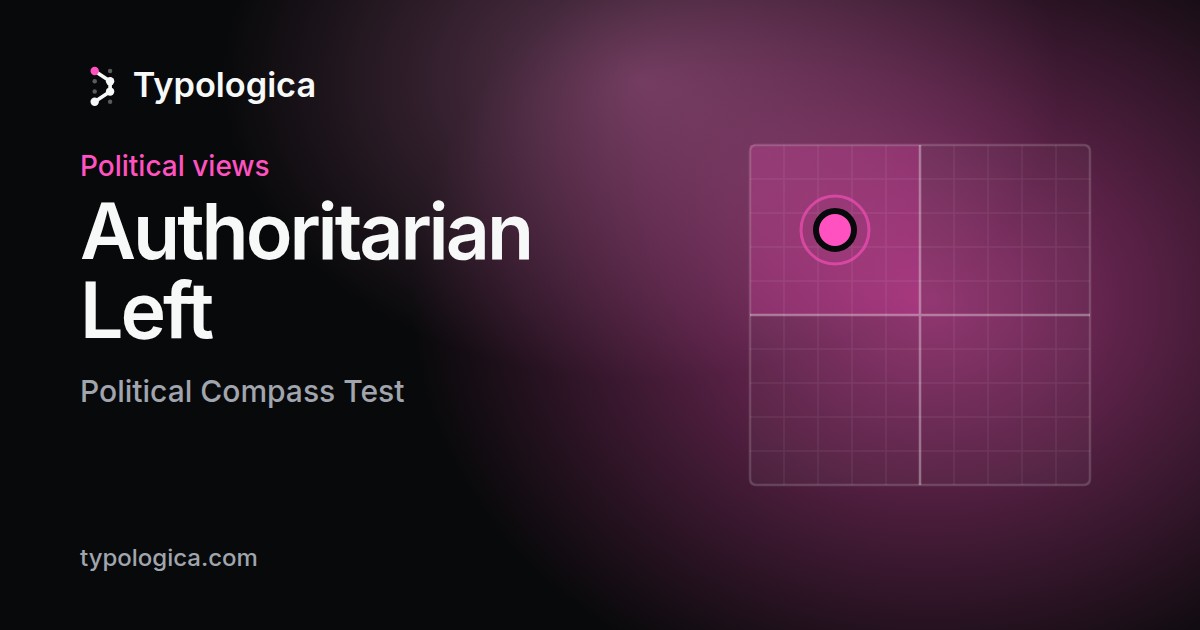
Authoritarian Left
This type wants fair shares and one set of rules for everybody.
In a team, it is the one who draws up the shared rota and checks that the quiet colleague gets a fair portion of the interesting work. Deadlines matter to it mostly as a way of keeping the load even.
With friends it pools things, a kitty for the trip, say, and expects everyone to keep to the plan the group agreed on. A member who skips the plan hears about it, kindly but plainly.
Decisions come down to what holds a group together and keeps it even-handed. That makes this type dependable when a project needs steady hands, and quick to notice who has been left out. It can be slower to warm to a person who handles things in a private way, and a routine may stay in place long after it has stopped serving anyone.
It helps to ask the group once a season which rule it would drop if it could, and to hear the answers out.
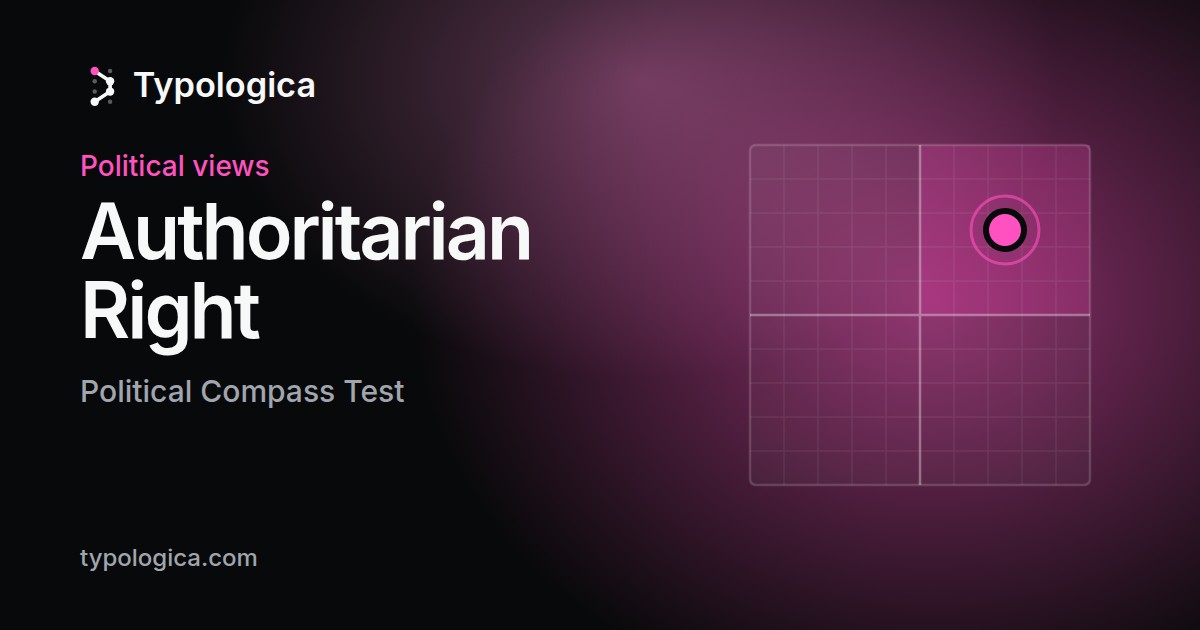
Authoritarian Right
Paying its own way and keeping standards high come naturally to this type.
A neighbor in trouble gets help from it, and it likes that help to come from people nearby who know the situation, each household keeping its own books. A favor is remembered for years and returned in kind.
In a company it backs clear job descriptions and rewards that follow results, and it remembers who delivered what. A promise made over a handshake counts for as much as one on paper.
Track record and past practice weigh heavily when it chooses. Under pressure the type stays steady and is hard to rush into a gamble. A newcomer's idea may wait a while for credit, and a person who fell behind through plain bad luck may find the type more demanding than expected.
It is worth checking what the existing rule was meant to protect before approving an exception, and noting the answer beside the request.

Libertarian Left
Libertarian Left backs a safety net for all and few rules for private life.
Decisions begin with two questions: who could be hurt, and who is being told what to do. The type is an easy ally for whoever's situation is unusual. It would sooner talk a rule through with the people it binds than announce it.
At work this type is the colleague who shares a contact list freely and argues for the quiet person's idea in meetings. It tends to ask what the schedule would look like if everyone's circumstances counted.
A friend who is short that month finds this type covering a cost and asking no questions about how anyone spends a weekend. Meetings can run long and threads stay open, since a shared plan that nobody is ordered to follow depends on everybody choosing to.
Libertarian Left can start each project by writing down who makes which decision and who can overrule it.

Libertarian Right
Libertarian Right starts things and leaves others to start theirs.
It asks who gets to choose and who bears the cost, and acts once that is clear. That makes the type quick to launch and slow to hand out opinions about how others live. It would sooner try a thing out than hold a long meeting about it.
At work it likes a small team with wide latitude and pay that follows results, and it leaves an overmanaged job sooner than a modest salary. A pay dispute is settled in a short direct conversation.
It splits the bill by what each person ordered and lends money readily, expecting it back, with terms said aloud before the money moves. It may overlook the person who cannot simply choose a way out of a bad stretch, since it is more used to offering advice than a hand.
This type might set aside an afternoon each week for helping a colleague with whatever is stuck.
Keys 1–4 pick an answer
Continue the test?
Answers not sent
The result didn’t arrive because the site couldn’t be reached. All your answers are saved in this browser, so there’s no need to retake the test.
Your type:
One type that explains it all
Five tests, five results, and not one tells you why the same things keep happening to you. The CoreTypes system gives the answer many people spend years looking for: why your life plays out exactly the way it does.
Take the free testOther types
Select a type to read its description and compare it with yours.
About the test
Methodology
The test is based on the approach of describing political orientation on two independent dimensions instead of a single left–right line. The first, Economy, covers the role of the state or community in economic life: sharing resources and regulating activity at the Left pole, private provision and market outcomes at the Right pole. The second, Power, covers how much authority should shape personal and moral life: shared standards and tradition at the Authority pole, individual choice and open dissent at the Freedom pole.
Twenty-four questions alternate between the two dimensions, twelve for each. Every question has four answers, two toward each pole of its dimension, worth three points when strong and one point when moderate. Points are added up per pole, and the pole with the higher total wins the dimension. On an exact tie the result goes to Right on Economy and to Freedom on Power.
The two winning poles combine into one of four results: Authoritarian Left, Authoritarian Right, Libertarian Left and Libertarian Right. These names mark areas of the field that the two dimensions form, and the bars on the result screen show how each total divided between its poles. The questions stay at the level of general values and name no parties, politicians or laws. The test rests on what a person reports about themselves.
Background reading: the left–right political spectrum and how political positions are mapped.
Author: Lex Tarrel, Creator of the CoreTypes system
Sources
- Eysenck, H. J. (1954). The Psychology of Politics. London: Routledge & Kegan Paul.
- Treier, S., & Hillygus, D. S. (2009). The Nature of Political Ideology in the Contemporary Electorate. Public Opinion Quarterly, 73(4), 679–703.
- Feldman, S., & Johnston, C. D. (2014). Understanding the Determinants of Political Ideology: Implications of Structural Complexity. Political Psychology, 35(3), 337–358. doi:10.1111/pops.12055.
Frequently asked questions
How does a political compass test work?
A political compass test sorts answers along two separate lines. One line is about money: whether wealth and services are better handled together or by each person for themselves. The other is about rules: whether the community should set the terms of private life or leave them to the individual. The result is the area where the two winning sides meet.
Is the political compass test based on research?
The two-line scheme goes back to decades of political science work. Researchers using different methods keep finding that attitudes toward economic questions and attitudes toward social authority form two clusters that move fairly independently. This test follows that layout and keeps its questions at the level of everyday values, so each answer feeds one cluster.
How is a political compass different from a left–right spectrum?
Someone can favor shared provision of everyday needs and still want wide personal freedom, or the reverse. A single line from left to right cannot show that, since it gives one number to two separate preferences: how wealth should be shared, and how far rules should reach into private life. Research finds the two only loosely tied, so a compass keeps both and ends with four areas instead of two ends.
Does the test work the same way in every country?
Yes. The questions describe general values, such as what a fair result looks like and who should have the final word. No party, politician or local law appears in them, so a situation reads the same in any place.
Is liberal the same as left, and conservative the same as right?
The test names each line for what it asks. On the money line, Left puts weight on pooling resources and rules for business, while Right puts weight on private provision and open markets. On the rules line, Authority puts weight on shared standards and tradition, while Freedom puts weight on personal choice and dissent. Familiar labels move from country to country: liberal names one side of the spectrum in some places and market-minded views in others, and left and right shift in similar ways. Each result name joins one side from each line.