RIASEC Test
This RIASEC test, also known as the Holland Code test, gives you 30 questions with four work activities each. Pick the one that appeals to you more, even when several seem close, and move on without going back. It takes about 6 minutes. At the end you see which of the six work interest types, as named in Holland’s approach, led your answers.
Realistic
The Realistic type measures a day by what stands finished at the end.
Building and repairing sit at the center. A fence goes up and an engine starts, and feedback is immediate: a bolt either tightens or strips. Tools and raw materials fill the working day, much of it outdoors or on the move.
Decisions follow what works. A repair is judged by whether it holds, a plan by whether it can be built, and a quick demonstration often replaces a long explanation.
Waiting on approvals or sitting through long planning talks wears on this type, since progress is easiest to see when the hands are busy.
Workshops and building sites give this interest room to fill the day, and robotics technicians and carpenters, for example, make a living in them.
It helps to keep a hands-on project of one's own going, such as restoring an old bicycle, to have something to finish between assignments.
Investigative
Investigative types want to know how things work and why.
A puzzling result holds more interest than a settled one. This type likes testing ideas and following a question for as long as it stays open, and a long stretch alone with a hard problem makes a good day, even when the answer is slow to arrive.
Living things and human behavior are common subjects, in a lab or in a data archive. Chemists and biologists, for example, build their work around questions of that kind.
With colleagues, this type is direct and curious about the reasoning behind a view. A claim without evidence prompts a polite request for the evidence. Meetings run long when a good question appears.
Rereading a paper twice to check one footnote is no chore here, and unfinished questions travel home in the head.
This type may start by keeping a running list of open questions and choosing one to chase down.
Artistic
Artistic types are drawn to making something that did not exist before.
Original work in image, text or sound draws this type, along with projects where the maker decides the form and the method. Musicians and craft artists work this way daily, in studios and at kitchen tables.
How things look matters too. This type notices how a room or a page is laid out and cares about small choices of color and spacing.
Feedback on a finished piece gets taken seriously, and the piece usually does the talking. Open form is part of the attraction, with the maker supplying the structure.
Ideas arrive in bursts, so the day bends around the work, and a deadline is often the thing that finally ends it.
This type may start with a small standing habit, such as a page of sketches or a few lines of writing before the day begins, to keep making things between big projects.
Social
Social types find a day worthwhile when someone else has moved forward.
Helping and teaching fill the working days of this type. The work centers on another person's learning or a personal difficulty, and that person's progress finishes the task.
In conversation, this type listens first and adjusts to the pace of the person in front of it. Group sessions and one-to-one talks both feel like natural work.
Elementary school teachers and guidance counselors work this way, as do people in personal service, where a visitor's need sets the agenda for the hour.
The day runs on other people's needs and schedules, and rewards arrive through someone else's progress. A full calendar of other people's requests is normal, and personal time has to be guarded on purpose.
It helps to set aside a short stretch of the day with no one's needs in it, which keeps energy for others from running low.
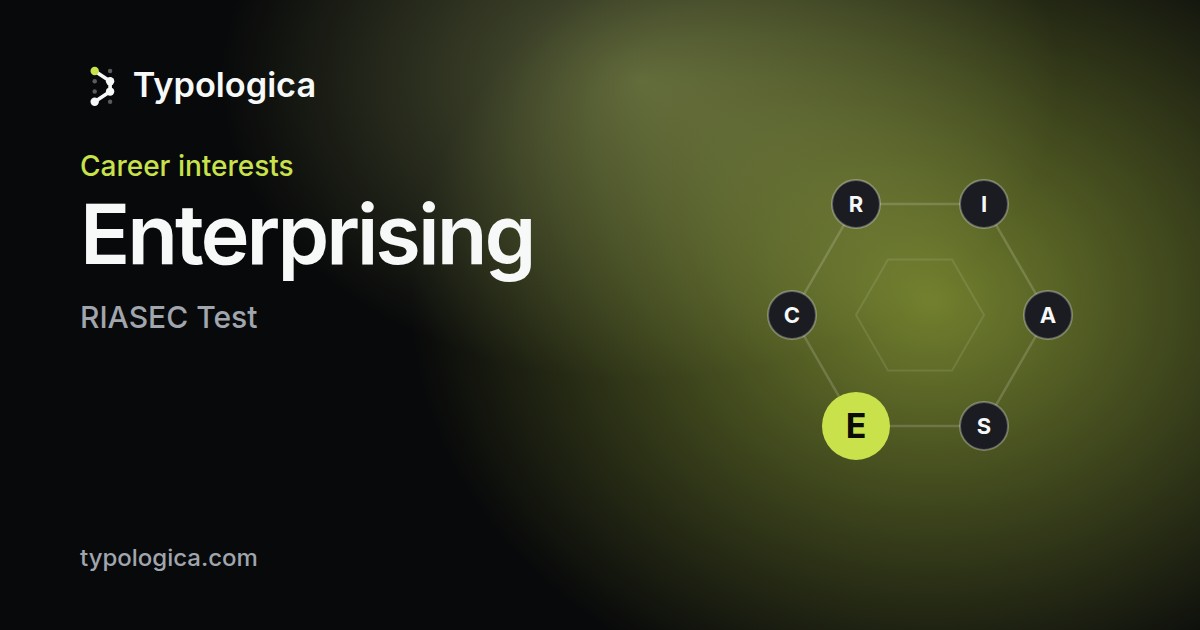
Enterprising
Setting a direction and bringing others along comes naturally to Enterprising types.
Leading projects and teams and making the calls is where the interest points. Persuading and negotiating are enjoyable parts of that, as is speaking for others in business, political or legal matters. Advertising managers and lawyers do this daily.
Among people, this type is outspoken and quick to take charge when a group stalls. An offer or an idea is something to put to others, and a yes after a good conversation is a satisfying result.
Goals drive the day, results get tracked, and decisions are made on the move.
A project with a visible finish line and a team to rally gets this type moving, and the opening weeks of a new venture hold special appeal. Long study alone with a table of facts rarely holds the same energy.
This type may start by asking for one dissenting opinion before committing to a decision.
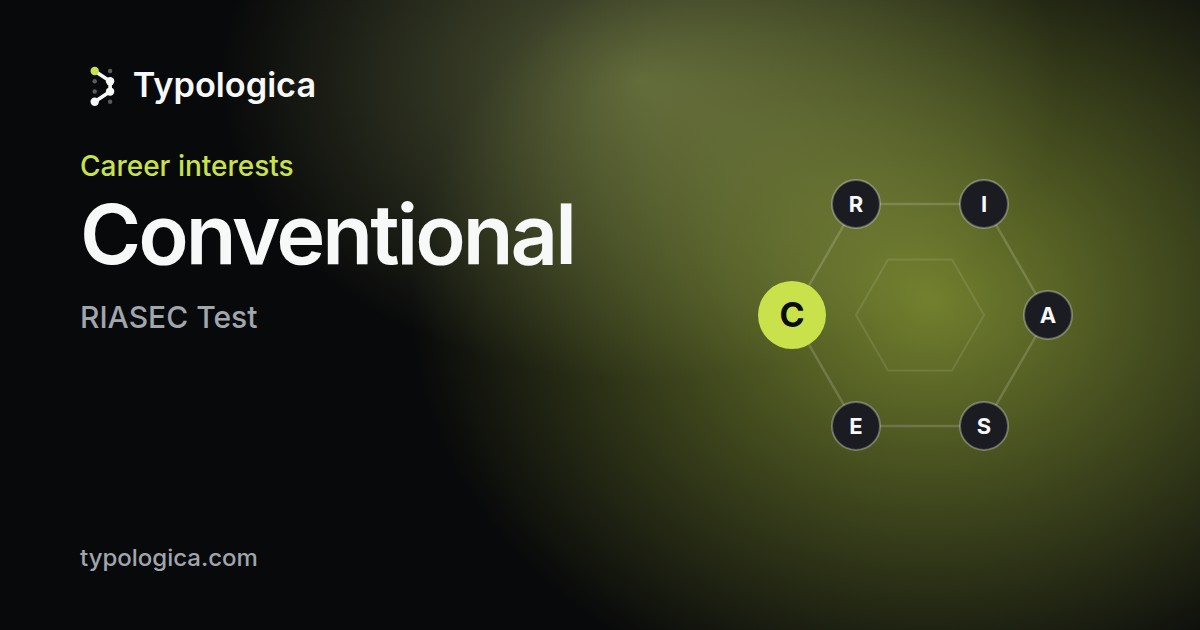
Conventional
For Conventional types, a day goes well when the records are right.
Keeping information in order sits at the center: files sorted and figures reconciled. Procedures and rules set the steps, and the work gains from following them closely.
Spreadsheets and record systems are the everyday tools, used by general office clerks and database administrators among others. A mistake in an entry gets noticed here before anyone else sees it, and an inconsistent date format stands out at once.
Colleagues find this type steady and dependable, and a clear request in a clear format is welcome. A handover note or a documented process earns quiet approval, and a column that finally adds up is a small daily pleasure.
Room for improvising is limited, and open-ended tasks with no set format take more effort and some deliberate planning.
It helps to write down the steps of a routine task once, because a clear checklist frees attention for the exceptions.
Keys 1–4 pick an answer
Continue the test?
Answers not sent
The result didn’t arrive because the site couldn’t be reached. All your answers are saved in this browser, so there’s no need to retake the test.
Your type:
One type that explains it all
Five tests, five results, and not one tells you why the same things keep happening to you. The CoreTypes system gives the answer many people spend years looking for: why your life plays out exactly the way it does.
Take the free testOther types
Select a type to read its description and compare it with yours.
About the test
Methodology
Each of the 30 questions lists four work activities, and each activity belongs to a different one of six types. Choosing an activity adds a point to its type. The type that collects more points than any other is the result, and a tie goes to whichever tied type comes first in the sequence R, I, A, S, E, C.
The test is based on Holland's RIASEC approach to vocational interests, and the questions were written from scratch for it. The letters stand for Realistic, Investigative, Artistic, Social, Enterprising and Conventional. An interest type names a kind of activity a person is drawn to, such as building or researching, helping or leading. Abilities and personality are separate matters.
Because every question sets four activities against one another, the result reflects what attracted the participant more than the alternatives on offer. Percentages, when displayed, show how the participant's own answers divided among the types.
The six names mark regions of a hexagon-shaped map of interests. Types next to each other are close in character, and types across from each other differ more. The test rests on the answers a person gives about themselves.
A plain-language overview of the six types and their order is available on the Holland Codes page of Wikipedia.
Author: Lex Tarrel, Creator of the CoreTypes system
Sources
- Holland, J. L. (1997). Making vocational choices: A theory of vocational personalities and work environments (3rd ed.). Psychological Assessment Resources.
- Tracey, T. J. G., & Rounds, J. (1993). Evaluating Holland's and Gati's vocational-interest models: A structural meta-analysis. Psychological Bulletin, 113(2), 229–246. doi:10.1037/0033-2909.113.2.229
- Rounds, J., Putka, D. J., & Lewis, P. (2023). Updating vocational interests information for the O*NET content model (O*NET report 2022 No. 117). National Center for O*NET Development, US Department of Labor.
- Rounds, J., & Tracey, T. J. (1996). Cross-cultural structural equivalence of RIASEC models and measures. Journal of Counseling Psychology, 43(3), 310–329. doi:10.1037/0022-0167.43.3.310
Frequently asked questions
How accurate is the RIASEC test?
The result reports the type that gathered more of the answers when four activities competed in each question, so a person who keeps picking building and repair tasks lands on Realistic. The type description then gives a concrete picture of the daily activities behind it, which makes it easy to hold up against one's own preferences.
Which careers match each type?
Each type spans a wide range of occupations, from hands-on trades to research posts, and many occupations mix several types. For that reason the result names areas of activity and gives a couple of labeled examples. Conversations with people who do the work add detail that no type description holds.
What does RIASEC stand for?
The letters are the initials of Realistic, Investigative, Artistic, Social, Enterprising and Conventional, the six types of work interest in Holland's approach. A type describes the kind of activity that appeals, while abilities, personality and values belong to other measures. A three-letter code names a person's leading three types in order.
Why did another Holland test give a different result?
Interests keep developing through school, first jobs and new experiences, so a result may shift over time, and a retake after a while is reasonable. Tests also ask in different ways: some have people rate single activities, while this one makes them choose among four, which can bring a different type to the front.
Why does the test give one type and not a three-letter code?
Each question yields one choice among four activities, and the choices add up to one leading type, which matches the first letter of a code. Ranking all three letters reliably takes a longer inventory, so this test stops at the first and names it in full.