Temperament Test
Each of the 24 questions describes an everyday situation. Pick the answer that fits what you do or feel in it; there are no right or wrong choices. The test takes about 5 minutes. At the end you see which of the four classic temperaments your answers lean toward, with a short description and your position on each of the two traits.
Sanguine
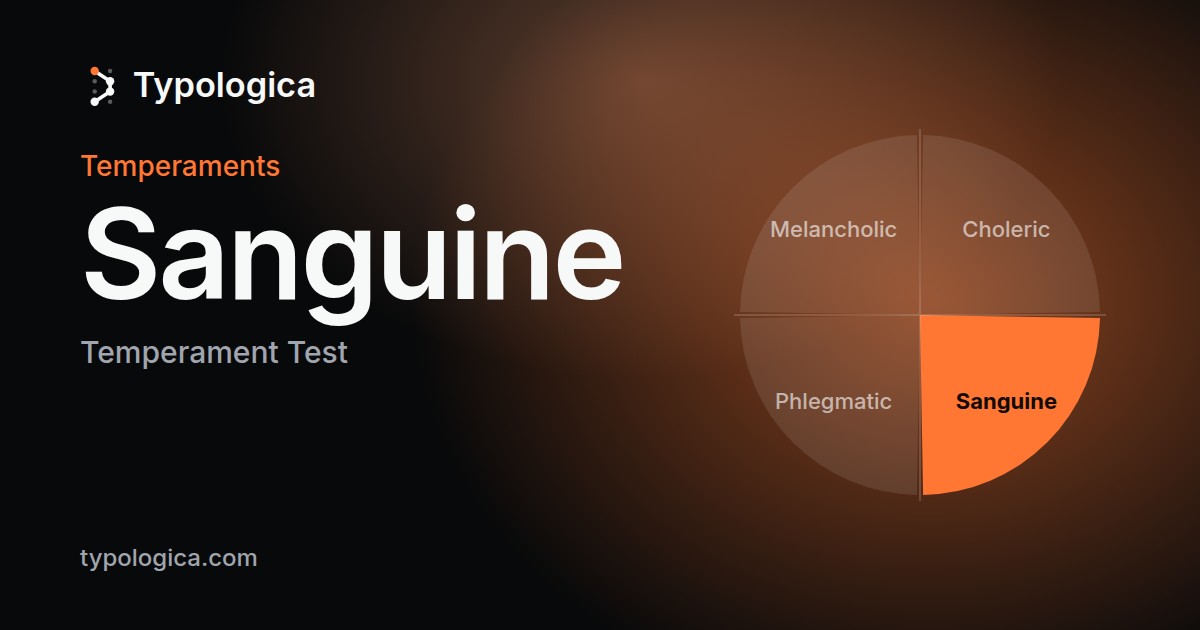
Sanguine is the temperament that walks into a room already talking.
At a party the sanguine person is the one introducing strangers to each other, and a spilled drink or a late guest gets a laugh. Small talk with a cashier or a neighbor comes as easily as a planned conversation.
At work a sanguine person volunteers early and is on good terms with a new team before the second meeting. Criticism or a canceled plan seldom changes the mood of the day.
Decisions tend to get made out loud. The sanguine person talks an idea through with whoever is nearby and often lands on a choice halfway through the sentence.
The weak spot sits next to the strength. Moving on fast can mean leaving a problem before anyone has looked at it properly, and a calendar full of people leaves little room for slow thinking.
Before closing a topic, it helps to ask whether the problem was solved or only the mood around it.
Choleric
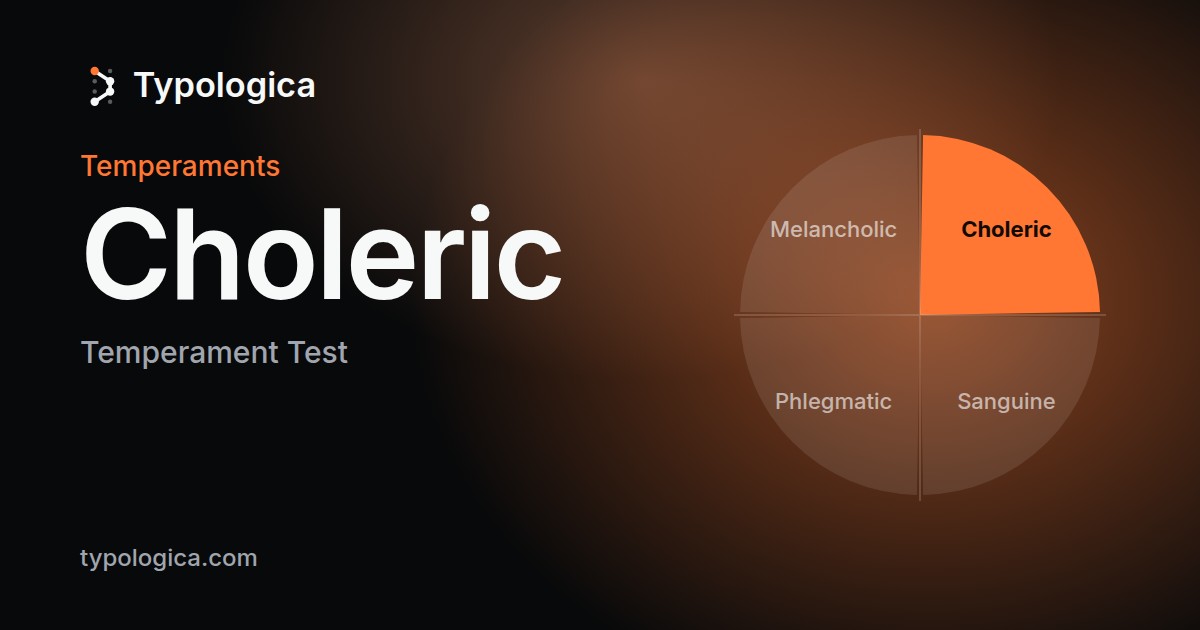
Quick to react and quicker to act, the choleric type goes straight at problems.
In a meeting the choleric person is the first to say what is wrong with the plan, and the face shows it before the words do. Irritation and enthusiasm both arrive within seconds and are plain to everyone in the room.
Handed a project, the choleric person takes the lead and sets the pace. Decisions come quickly, and so does impatience with colleagues who need longer.
A deadline sharpens this type. Lists get made, tasks get handed out, and the afternoon is organized before others have finished their coffee.
With colleagues and friends that drive can feel like pressure. A sharp remark in a meeting may be forgotten by the speaker long before the listener stops thinking about it, and the feeling often outlasts the situation that caused it.
Ten minutes between the first reaction and the reply work well for this type, in meetings and in messages alike.
Phlegmatic
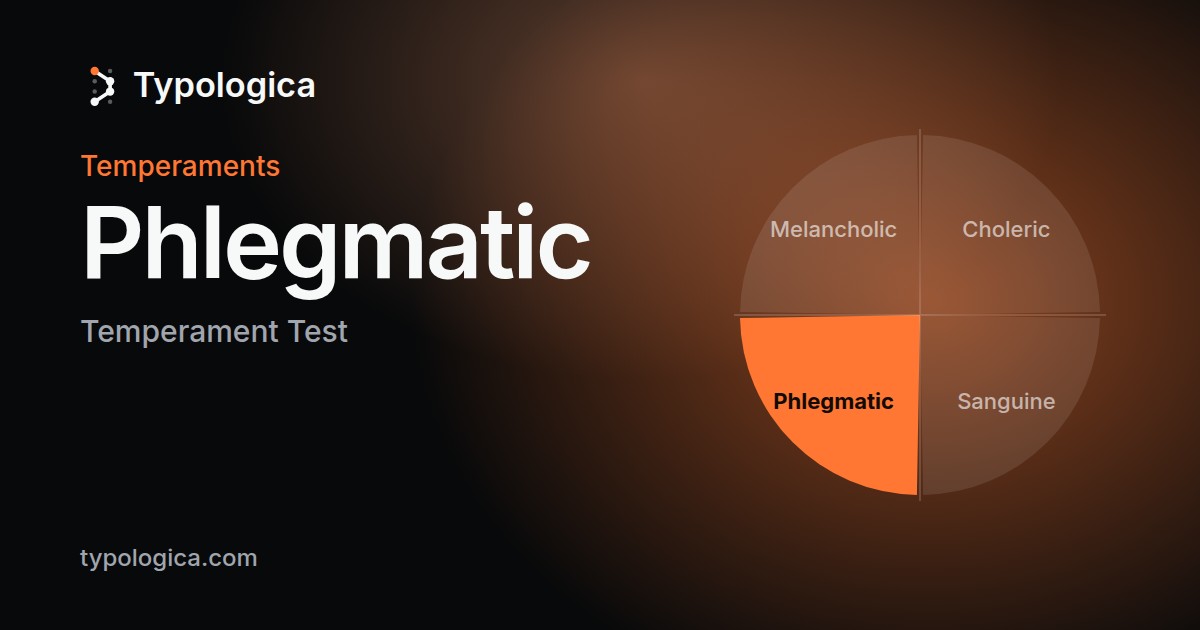
A phlegmatic person can sit through a noisy room and barely lift an eyebrow.
In a noisy open office the phlegmatic person keeps working at the same pace. A canceled meeting or an extra task gets a nod, and the evening plan stays as it was. A free night at home with a book or a project is a good night, and one close friend is plenty of company.
Colleagues rely on the phlegmatic person: the deadline is met and the tone stays level even when the room is tense.
In friendships the phlegmatic type listens patiently and takes offense slowly. Plans can change without a fuss, though the same ease may leave a friend guessing what the person actually wants.
From outside, the calm can pass for indifference. A quiet person with a quiet reaction may say nothing about a problem that matters to them, and others take the silence for agreement.
One habit helps this type: say the thing that matters out loud at the start of a conversation, before the topic moves on.
Melancholic
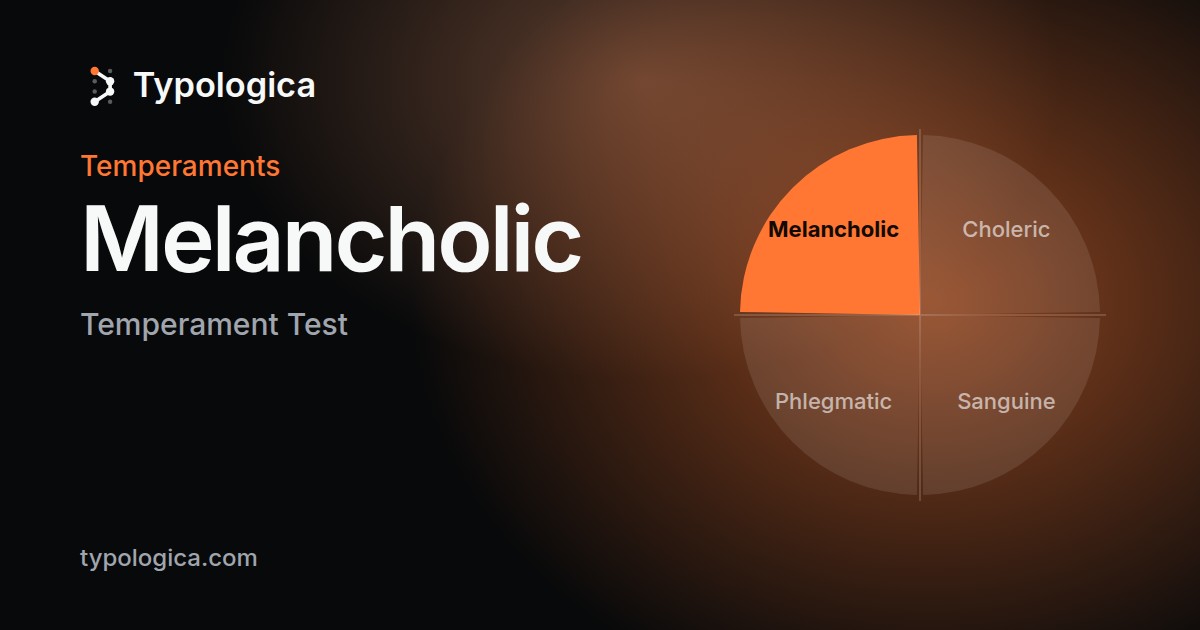
Feeling things strongly and thinking them through alone comes naturally to the melancholic type.
After an unkind email the melancholic person feels it at once and keeps it to themselves, with little showing on the face. An evening out is enjoyed in small doses, and a quiet night at home restores more.
Details get the melancholic person's full attention: the flaw in the plan gets spotted and the email gets reread before it goes out. Preparation often runs past what the task asks for, which suits jobs where details matter.
With people this type picks one or two close friends and talks at length, sometimes about a single worry. Small talk at a crowded gathering tires it quickly.
A passing remark can turn into an afternoon of replaying it. A strong reaction tends to get worked through alone, so colleagues may not know that anything was wrong.
Telling one trusted person about a strong reaction while it is fresh, even in a single sentence, gives the feeling somewhere to go.
Keys 1–4 pick an answer
Continue the test?
Answers not sent
The result didn’t arrive because the site couldn’t be reached. All your answers are saved in this browser, so there’s no need to retake the test.
Your type:
One type that explains it all
Five tests, five results, and not one tells you why the same things keep happening to you. The CoreTypes system gives the answer many people spend years looking for: why your life plays out exactly the way it does.
Take the free testOther types
Select a type to read its description and compare it with yours.
About the test
Methodology
The test is based on the idea that the four classic temperament names mark out four quadrants defined by two continuous traits. One trait is social energy, running from turned toward other people to turned inward. The other is emotional reactivity, running from steady to strong and fast. Crossing them gives four quadrants, and each carries one old name as a label for that quadrant: sanguine, choleric, melancholic or phlegmatic.
The 24 situations split evenly, 12 for each trait. Each offers four answers: two lean toward one end of the trait and two toward the other, and at each end one answer is strong (3 points) and one milder (1 point). Points collect separately at each end across the 12 situations, and the end with more points decides that trait. A dead heat goes to the inward end of social energy and the steady end of reactivity, since those make the more modest claim. The two decisions together give the result. The result rests on what a person says about their own habits and reactions.
Further reading: what temperament means and how genes and environment contribute (MedlinePlus) and the history of the four temperaments (Wikipedia).
Author: Lex Tarrel, Creator of the CoreTypes system
Sources
- Stelmack, R. M., & Stalikas, A. (1991). Galen and the humour theory of temperament. Personality and Individual Differences, 12(3), 255–263.
- Eysenck, H. J., & Eysenck, M. W. (1985). Personality and Individual Differences: A Natural Science Approach. Plenum Press.
- Longley, S. L., Miller, S. A., Broman-Fulks, J. J., Calamari, J. E., Holm-Denoma, J. M., & Meyers, K. (2017). Taxometric analyses of higher-order personality domains. Personality and Individual Differences, 108, 207–219.
- Thomas, A., & Chess, S. (1977). Temperament and Development. Brunner/Mazel.
Frequently asked questions
What does my temperament result mean?
A temperament result describes a position on two everyday traits: where energy goes (toward people or inward) and how emotions respond (steadily or strongly). Each of the four combinations carries an old name, and the result shows the name that belongs to the position the answers point to.
Temperament vs personality: what is the difference?
Personality is the full picture of how a person feels and acts, built up over a lifetime. Temperament is the part that shows up early in life, with a strong biological footing, and experience builds on it from there.
Is temperament inherited or learned?
Heredity and environment both play a part. Genes contribute to differences in social energy and emotional reactivity, while upbringing and life events keep shaping them as a person grows. Neither side explains everything, and a single result is a snapshot of the present.
Can someone be a mix of two temperaments?
Yes. With two graded traits underneath, a person can sit halfway along one trait and clearly toward an end of the other, which reads as a mix of neighbors such as sanguine and choleric. Blends are the expected outcome, since the four names are boundaries drawn across a range.
How common is each temperament?
The test page shows how often each result turns up among the people who have taken the test. The distribution updates as more people finish it.