Work Interests Test
Each of the 36 questions describes a task that could be part of a job, with five answers to choose from. Pick the answer that matches what you would do or want to do, and set aside the training the task would need. The test takes about 8 minutes. At the end you see your leading interest area, a description of how it shows up at work, and six scales for all the areas.
Realistic
Realistic types want to see a real thing come out of the day's work.
The pull is toward practical jobs, such as rewiring a lamp or laying out a garden bed, and toward tools, machines, plants and animals. Many people of this type like the work outdoors, where there is weather to deal with and a result to point at.
Faced with a problem, this type reaches for a solution that can be tried at once. A jammed gate gets oil and a leaking pipe gets a clamp. Then the day moves on with something fixed behind it, which is what carpentry or farm-equipment repair, for example, offers from morning to evening.
Explaining why a thing behaves as it does gets less attention, and so does the paperwork around it. A repair done well can leave no note behind for the next person, who then has to find the cause all over again.
A Realistic person may start by writing two lines after each job: what was done and what was used.
Investigative
Why something works the way it does is the question Investigative types keep asking.
They are drawn to studying and testing, and a single question can hold their attention for a long time. Facts and ideas are the material, and a hunch counts only once something backs it up. A long reading list is a normal part of the week.
The search for the explanation can run ahead of the doing. A project may be understood in every detail while this type is still checking one more source, and persuading a room to act on the findings often comes last.
Evidence is the strong side here. Before repeating a claim, this type checks it, and a vague suspicion becomes an experiment someone can run. Laboratory research and data analysis give that habit plenty of room and a steady supply of puzzles.
It helps to name, at the start, the point at which the findings are good enough to act on.
Artistic
Room to make something that did not exist before is what Artistic types need.
They are pulled toward writing and design, and toward any job where the approach is theirs to choose. Illustration, sound design or a small theater company leave that choice open.
A blank page reads as an invitation. The first idea often arrives as an image or a phrase before there is any plan for it, and a finished piece that carries the maker's own view is the point of the effort.
Feedback lands well when it comes from someone who also makes things.
Fixed procedure is the sore spot. Naming rules and approval stages can feel like walls around the work, and this type usually deals with them last, sometimes after a reminder from a colleague.
An Artistic person can begin with one fixed routine, such as a standing hour each week for the paperwork, and leave everything else loose.
Social
For Social types, the point of work is another person's growth.
Teaching and advising draw them, and so does caring work in clinics and classrooms. Nursing and teaching put the whole day inside someone else's progress, and that is where this type feels the work has a purpose.
Helping the person can come before moving things toward a result. A session that went warmly but settled nothing still feels like a good day, while the agenda quietly slips and the next person in the queue waits.
Warmth and close attention to how another person is doing are the working tools here, and a conversation counts as real work. Colleagues and clients tend to bring this type their problems first, because they expect to be heard. Groups and one-to-one sessions both suit this type, and the pace follows the other person.
It is worth deciding in advance what each meeting should produce, and writing that at the top of the notes.
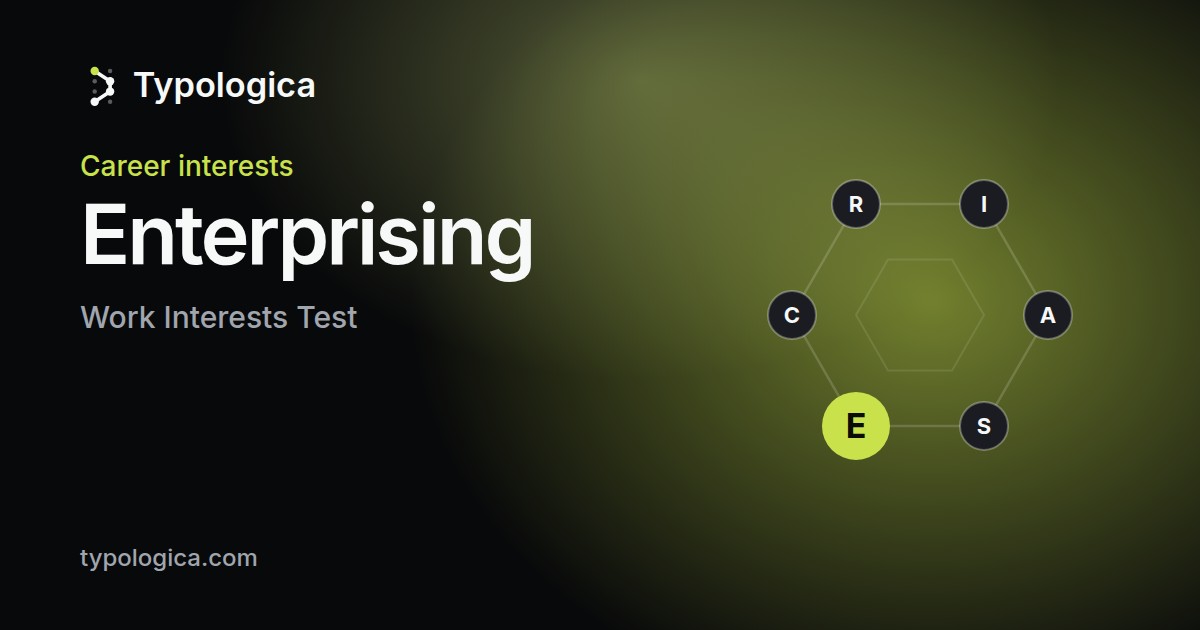
Enterprising
Enterprising types like to take charge and move people toward a goal.
Persuading and negotiating appeal, and so does deciding, especially in business or politics, where there are rivals and some risk. Sales leadership or a position in law, for example, puts that pull to daily use.
This type decides what a drifting meeting leaves open and puts a name to a stalled plan. The energy comes from the contest as much as from the result, and a deal that is still open holds more interest than one already signed.
Rooms full of people are the natural workplace, and a pitch or a hard negotiation counts as a good morning.
Pushing for the outcome sometimes leaves the people carrying it a step behind. Colleagues may feel hurried along, and the records that keep a project honest can stay unwritten for a while.
An Enterprising person might try asking each team member, before a big decision, what could go wrong from where they sit.
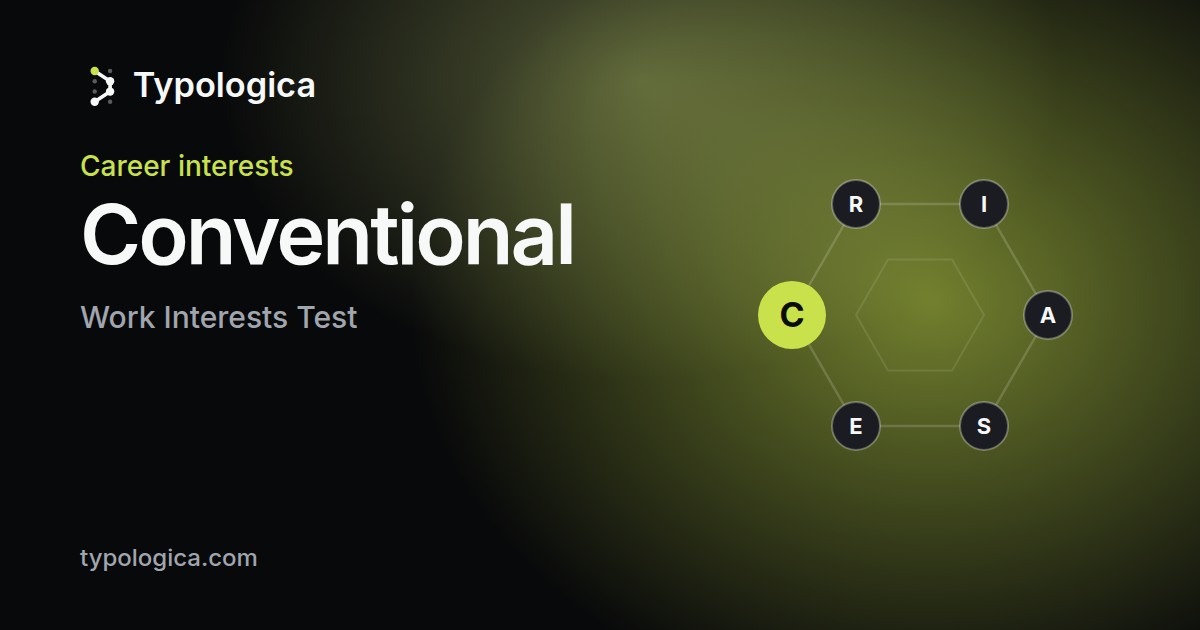
Conventional
Clear rules and accurate records make work feel right to Conventional types.
Filing and checking figures feel natural to them, and so does following a set standard. Bookkeeping and records management are built from these tasks, in settings with a clear order and a clear owner for every item.
What this type hands over is complete and can be relied on. A report arrives with every field filled, and a figure in it matches its source. Colleagues learn to trust that a folder from this desk needs no second look.
Keeping the system correct can leave little appetite for running it. This type may stay with the files and let someone else do the steering, even when the job would suit them. The same carefulness shows up in small things, like a calendar where every meeting has an agenda attached.
It pays to say one idea for improving the process out loud each month, even a small one.
Keys 1–4 pick an answer
Continue the test?
Answers not sent
The result didn’t arrive because the site couldn’t be reached. All your answers are saved in this browser, so there’s no need to retake the test.
Your type:
One type that explains it all
Five tests, five results, and not one tells you why the same things keep happening to you. The CoreTypes system gives the answer many people spend years looking for: why your life plays out exactly the way it does.
Take the free testOther types
Select a type to read its description and compare it with yours.
About the test
Methodology
The result names the leading area of work interest and shows six scales from 0 to 100 percent, one for each area. The scales show how clear the lead is.
The test has 36 questions, six for each area, shown in rotation. Every question describes a work task and offers five answers, from a light pull toward the task to a strong one. A strong answer adds points to the area the question belongs to, while every other area receives the same small base from every question, so an area's total grows only with its own six questions. If two areas finish level, the one that comes first in the list below leads.
The test is based on Holland's approach, which sorts work interests into six areas: Realistic, Investigative, Artistic, Social, Enterprising and Conventional. They sit at the corners of a hexagon, where neighboring areas share more ground than areas far apart.
The six names label regions of one field of interests, so a profile can sit near the border between two of them. The test rests on a person's own answers about themselves. A plain-language introduction to the types and the hexagon is on Wikipedia.
Author: Lex Tarrel, Creator of the CoreTypes system
Sources
- Holland, J. L. (1997). Making vocational choices: A theory of vocational personalities and work environments (3rd ed.). Psychological Assessment Resources.
- Rounds, J., & Su, R. (2014). The nature and power of interests. Current Directions in Psychological Science, 23(2), 98–103. doi:10.1177/0963721414522812
- Rounds, J., Hoff, K., & Lewis, P. (Eds.). (2021). O*NET Interest Profiler manual. National Center for O*NET Development, U.S. Department of Labor, Employment and Training Administration.
- Nauta, M. M. (2010). The development, evolution, and status of Holland's theory of vocational personalities: Reflections and future directions for counseling psychology. Journal of Counseling Psychology, 57(1), 11–22. doi:10.1037/a0018213
Frequently asked questions
Is the test free?
Yes. The test is free and is taken online. It is an independent interest quiz that follows the six-area model of Holland and uses thirty-six original questions.
What does the test measure?
How strongly a person is drawn to six kinds of work activity: building and repairing things, finding out how and why, creating, helping, leading and persuading, and organizing. The result is a leading area plus six scales, one for each area.
How accurate is the result?
The result shows which kinds of work pull a person. The six areas form a general map of interests, and each area holds narrower interests inside it. Interests keep developing, so taking the test again after some months or years is reasonable.
Is there a PDF or printable version of the questions?
The thirty-six questions are original and written for the online format. Each one describes a work task and offers five answers, and the whole set is answered on screen.
What do the results mean, and what are preparation levels?
The leading area is the one whose scale stands above the others, and the six scales show how the rest line up. Neighboring areas on the hexagon (Realistic and Investigative, Investigative and Artistic, Artistic and Social, Social and Enterprising, Enterprising and Conventional, Conventional and Realistic) overlap, so a pull toward two at once is common. Preparation levels are a separate reference: five steps that describe how much schooling, training and experience a line of work usually calls for, from almost none to graduate study. Work in every area exists at several levels, and the choice of level is the reader's own.